
Capturing Siblings: How to Photograph the Bond Between Brothers and Sisters
The Moment You Almost Missed
It happens in a blink.
Your eldest reaches over and squeezes her little brother's hand. He looks up at her, not for the camera, not because you asked him to, but because she's his person. His safe place. His partner in every backyard adventure.
And then it's gone.
That's the heartbreak of sibling photography done wrong: the poses are perfect, the light is golden, but the moment, the real one, slipped right by.
If you've ever walked away from a sibling photo session wishing you had captured more, you're not alone. Photographing the bond between brothers and sisters is one of the most rewarding, and most challenging things a family photographer can do. It requires more than technical skill. It requires patience, strategy, and the ability to become invisible so the real magic can unfold.
In this guide, you'll learn exactly how to do that.

Why Sibling Photography Is Unlike Any Other Portrait Session
Most portrait photography is about the individual. Even couples photography has a certain performance quality to it - two people presenting themselves to the world together.
Sibling photography is different.
It's about a relationship, a bond built in the trenches of shared bedrooms, stolen Halloween candy, and whispered secrets after bedtime. It's messy, layered, and completely irreplaceable.
According to child development research, the sibling relationship is often the longest relationship a person will have in their lifetime, longer than the relationship with parents, longer than marriage. That bond deserves to be documented with the same intentionality we bring to wedding photography or newborn sessions.
When you walk into a sibling photo session, your job isn't to take pretty pictures of two kids sitting nicely. Your job is to tell the story of who they are to each other.
That changes everything about how you approach the session.

The 3 Biggest Mistakes Photographers Make with Sibling Sessions
Before we get into what works, let's talk about what doesn't.
Mistake #1: Forcing the Pose
"Okay, everyone look at the camera and smile!"
You already know what happens next. One child refuses. The other overperforms. The authentic connection between them evaporates the moment they're asked to perform for a lens.
Genuine sibling moments, the ones that make parents cry when they see their gallery, are never posed. They're prompted.
Mistake #2: Photographing Kids the Way You'd Photograph Adults
Adults understand the social contract of a photo session. Kids don't care. They're hungry, or bored, or desperate to show you the beetle they found near the fence.
The best children's photographers know that you don't direct children, you follow them.
Mistake #3: Ignoring the Age Gap Dynamic
A 10-year-old and a 2-year-old operate in completely different emotional and physical worlds. So do teenage siblings. So do twins. Each sibling combination has its own energy, its own language, its own unspoken hierarchy.
Understanding the age dynamic before you press a single shutter button is critical.

The Hero's Journey: Your Client's Story
Before we get into the tactical tips, let's talk about the why - because understanding your client's emotional journey will make you a dramatically better sibling photographer.
Parents who book a sibling photo session aren't just buying pictures. They're trying to freeze time.
They know their kids won't be this age forever. They know the dynamic will shift - older siblings will leave for college, younger ones will grow up, distances will open between them. The sibling bond they see right now, in this exact season of their family's life, is fleeting.
That's what they're hiring you to preserve.
When you understand that, you stop worrying about whether everyone is looking at the camera. You start worrying about whether the image feels true. Whether it captures the relationship - the teasing, the tenderness, the inside jokes - in a way that will transport this family back to right now when they look at it twenty years from today.
That's the transformation you're offering. And it's profound.

8 Expert Techniques for Photographing Sibling Bonds
1. Start with Connection, Not Camera
Before you take a single photo, spend five to ten minutes with the kids. Get on their level - literally. Sit on the floor with them. Ask about their favorite video game. Let them inspect your camera. Let them be bored with you before they trust you.
Trust is the precondition for authentic photography.
Children who don't trust the photographer perform for them. Children who do trust the photographer forget about them, and that's when the real moments happen.
2. Use Prompts Instead of Poses
The difference between a prompt and a pose is everything.
A pose tells children where to put their bodies. A prompt creates an experience that naturally produces authentic moments.
Try these sibling photography prompts:
"Tell your brother the most embarrassing thing that ever happened to you."
"Pretend you just found out you're going on a surprise trip to Disney. React."
"Big sister, can you show your little brother something you're really good at?"
"Who's faster? On three, both of you run to that tree."
"Whisper your favorite thing about your sister in her ear."
These prompts create genuine emotional reactions. They create stories. And stories make photographs unforgettable.
3. Embrace the In-Between Moments
The best sibling photographs rarely happen during the "official" part of the session.
They happen when the older child fixes the younger one's collar before you start. They happen when one sibling whispers something that makes the other collapse into giggles. They happen in the walk from one location to another, when they think nobody's watching.
Keep your camera up. Keep your finger near the shutter. The moment you put the camera down is often the moment the magic happens.
4. Use Environment as a Storytelling Tool
Where you photograph siblings matters as much as how you photograph them.
A session in their own backyard - surrounded by the fort they built together, the trampoline they've launched themselves off a thousand times, the garden hose they've chased each other with all summer - will almost always yield more authentic images than a neutral studio backdrop.
If you're shooting outdoors, look for environments that invite interaction: open fields they can run through, paths they can walk together, water features that invite play. If you're shooting indoors, the family home is almost always the right choice for capturing the truest version of who these kids are to each other.
5. Master the Age Gap
Toddler + School-Age Child: Let the older sibling take the lead. Give them a "mission" - teach your brother this dance move, show her how to pick a flower, read her a page from your favorite book. The older child feels important; the younger one is naturally attentive.
School-Age Siblings (close in age): This is your most dynamic combination. These kids have a fully developed sibling language - the teasing, the inside jokes, the competitions. Lean into it. Set up gentle competitions or challenges and photograph the reactions.
Teen + Young Child: Teens are often the most self-conscious subjects. Defuse this by giving the teenager a role rather than a pose. Ask them to hold their little sibling's hand and walk down the path. Ask them to tell you what their sibling is afraid of. When teenagers feel useful rather than observed, they relax.
Twins: Twins have a connection that's almost telepathic. Rather than trying to create connection (you can't manufacture what they already have), focus on discovering it. Photograph their mirroring - the way they tilt their heads the same way, finish each other's sentences, reach for each other instinctively.
6. Nail Your Sibling Photography Lighting
The technical foundation of a great sibling photograph is good light.
For outdoor sessions, the golden hour - the 30 to 60 minutes after sunrise or before sunset - provides the warm, soft, directional light that makes skin glow and shadows gentle. This is especially important for siblings who are different heights or ages, as it creates an evenness that flatters everyone in the frame.
For indoor sessions, position your subjects near the largest window in the room. Avoid overhead artificial lighting, which creates harsh shadows under the eyes and nose.
When photographing multiple children, watch for one child casting a shadow on another, especially with height differences. Slight repositioning is often all it takes.
7. The Power of Unposed Candid Sequences
Some of the most powerful sibling photographs come in sequences - a series of 5 or 6 frames that tell a complete micro-story.
The older sister looks over at her brother. He looks up. Something passes between them - a secret, a joke, a shared memory. She laughs. He grins. She reaches over and ruffles his hair.
Each individual frame is good. But together, they're extraordinary.
When you feel a genuine moment building, don't shoot once and move on. Stay with it. Burst-shoot if you need to. Let the story complete itself before you lower your camera.
8. Create Space for Tender Moments
Not every sibling dynamic is loud and playful. Some of the most profound sibling bonds are quiet ones.
Build time into your session for stillness. Photograph them sitting together watching the sunset. Photograph the older one reading to the younger one. Photograph them simply existing side by side.
These quiet images often become the ones that matter most - the ones that hang on the wall for decades.
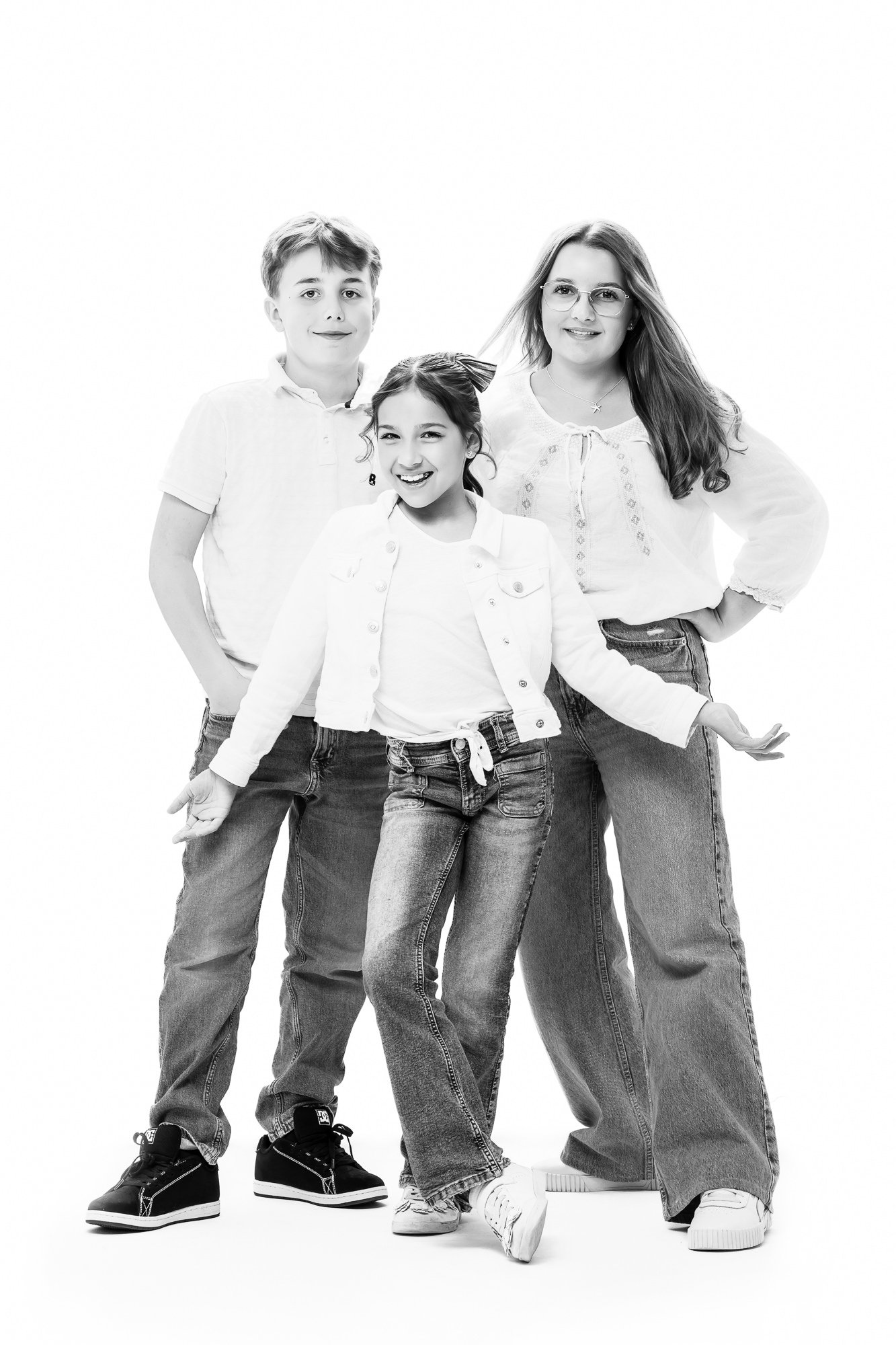
What to Wear: A Brief Guide for Parents
The right clothing makes a meaningful difference in sibling photography.
Avoid matching outfits - they flatten individuality and can make images feel dated quickly. Instead, aim for coordinated clothing: a shared color palette or complementary tones that feel cohesive without being identical.
Stick to solid colors or simple patterns. Avoid large logos, busy prints, or anything with writing on it - these draw the eye away from faces and expressions.
Most importantly, dress children in clothes they're comfortable in. An itchy dress or too-tight shoes will derail your session faster than anything else.
Preparing Parents for the Session
The parents you work with have enormous influence over how a sibling session goes - for better or worse.
Brief them in advance:
Schedule the session around nap times and meal times. A hungry toddler will not cooperate.
Bring snacks. Seriously.
Tell them that not smiling at the camera is not a failure. Some of the best images have nothing to do with the camera.
Remind them to hold back during the session. When parents hover or coach, children perform instead of connect.
Set the expectation that the session may feel chaotic - and that's exactly how it should feel.
The parents who walk in relaxed and trusting almost always walk away with extraordinary galleries. The parents who walk in anxious and controlling almost always don't.
After the Session: Curating the Story
When you sit down to cull and edit a sibling photography session, look for images that tell a sequence, not just individual standout frames.
The sequence that shows the lead-up, the moment, and the aftermath will always be more powerful in a gallery - and in print - than a single technically perfect image.
When presenting the gallery to parents, lead with the most emotionally powerful image. Not the most technically impressive one. The one that makes them feel something.
That image will be the one they print and frame. And it will be the image that keeps them coming back to you - year after year - to document their family as it grows and changes.
Ready to Capture the Bond That Lasts a Lifetime?
The sibling bond is one of the most complex, most beautiful, and most irreplaceable relationships in human experience. Photographing it well is a privilege, and a skill that rewards every hour you invest in learning it.
Whether you're a professional family photographer looking to elevate your sibling sessions, or a parent who wants to understand what goes into great sibling photography before you book your next session, the principles here will transform what you're able to capture.
Because the best sibling photographs aren't just images. They're time machines. They're the thing that will make a grown woman catch her breath when she comes across it in a box thirty years from now and remembers exactly who her brother was when he was five.
That's the work worth doing.
Related Posts You'll Love:
HOW TO CHOOSE THE RIGHT PHOTOGRAPHER FOR YOUR FAMILY PORTRAITS
HOW TO COORDINATE OUTFITS WITHOUT LOOKING OVER-STYLED (AND STILL LOOK AMAZING IN PHOTOS)
THE BEST TIME OF YEAR FOR OUTDOOR FAMILY PORTRAITS IN FLORIDA
About Sylwia Ok Photography
Sylwia Ok is an award-winning Sarasota and Lakewood Ranch family photographer specializing in fine art family portraits, sibling portraits, maternity, newborn, and Black Label portrait experiences. Her studio is located in Lakewood Ranch Corporate Park and serves families throughout Sarasota, Bradenton, Lakewood Ranch, Venice, St. Petersburg, and Tampa.
Through a personalized portrait experience, Sylwia creates timeless artwork that celebrates the relationships that matter most.
Keywords: Sibling Portrait Photography, sibling portraits, sibling photography, brother and sister portraits, sibling photo session, family portrait photographer Sarasota, Lakewood Ranch family photographer, Sarasota family photographer, professional family portraits, children's portrait photography, family photography Sarasota FL, fine art family portraits, family photography studio Sarasota
